Soft Snickerdoodle Cookies (Updated)

These are by far the softest and fluffiest cookies I have ever had. Ever. And so, like any amazing recipe, I had to share it and make sure it never disappears. The original recipe is from Mrs. Sigg’s.

The trick to these cookies is to make them by hand because it is easier to overwork the dough using electronic machines, thus, ruining the texture of the cookie. However, if you must break out the hand-mixer or stand-mixer, be sure to be wary about overworking the dough. Stop mixing immediately once the ingredients are homogeneous.

The perfect homemade treat with some tea.

I use an ice cream scoop to make the cookie sizes relatively even, but if you have a cookie scoop, that’s even better!

Since these cookies are really soft, it’s important to let the cookies rest after baking. Although it’s hard to resist oven-fresh cookies, these cookies will be too soft to handle fresh. Letting them cool will help the cookies harden slightly.

The total cost of a whole tray of medium-sized cookies for me was roughly $2.95.

Want something chocolate-y instead?

Fudgy Brownies (Updated)

Crispy top and melt-in-your-mouth interior…what other reason do you need to make these brownies?

Soft Snickerdoodle Cookies

  • Servings: 12, 3-inch cookies
  • Difficulty: easy
  • Print

Credit:  Mrs. Sigg’s. It’s very important to use room temperature unsalted butter in this recipe.

Ingredients

  • 8 Tbsp Unsalted Butter, at room temperature
  • 3/4 C. Sugar
  • 1 tsp Vanilla Extract
  • 1 Tbsp Cinnamon
  • 1 Large Egg, beaten
  • Roughly 1+1/3 Cup of Flour
  • 3 tsp Baking Powder
  • Cinnamon Sugar (3 Tbsp Cinnamon + 3 Tbsp Sugar)
  • Cooking Spray

Directions

  1. Whip butter until creamy. Add sugar, cinnamon, and vanilla. Mix until ingredients are all combined.
  2. Add in the beaten egg, and mix until combined.
  3. In a separate bowl, sift the flour and baking powder together. After sifting, add the dry ingredients into the wet ingredients. Fold wet and dry ingredients together with a rubber spatula until just combined.
  4. Preheat the oven to 400 degrees Fahrenheit. Line a cookie tray with parchment paper and grease with cooking spray.
  5. Use an ice cream scoop to portion the cookie dough into about 12 cookies.  With our hands, shape portions into balls.
  6. Coat the surface of the ball in cinnamon sugar by rolling the ball in a small bowl with cinnamon sugar. Place the coated dough balls onto the tray, allowing at least an inch of space around each cookie.
  7. Bake in the oven for 8 minutes or until edges start to brown. Allow cookies to rest at room temperature for at least 10 minutes before serving.

Warm up cookies older than a day by baking at 350°F for about 4 minutes.


Big thanks to my roommate who actually tests out my recipes. There are a lot of components of a recipe’s success that I am ignorant of until she lets me know. It is only because of this that I am able to edit and improve my recipes so I am incredibly grateful.

In the older version of this recipe, I was open about the fact that I had used salted butter with success for this recipe. It didn’t occur to me that I should’ve included a word of caution about selecting fats for cookies.

Generally speaking, I find that for cookie recipes, it is mandatory to use unsalted butter if that’s what it calls for. In desperate times, I have used salted butter before; however, I do not recommend it if it can be helped. It may seem obvious, but the salt in salted butter can mess up a cookie’s texture because salt produces moisture in the cookie dough when it bakes. It’s not an extreme difference though, which is why I was able to get away with it in this case. The consequences of substituting salted butter in more delicate cookie recipes could be way worse though.

It should be noted that some recipes call for salt even if unsalted butter is being used but this still doesn’t mean that using salted butter is okay. The salt added with unsalted butter is miles less than the amount in salted butter. That said, in my case where I used salted butter desperately, I would’ve skipped any additions of salt the recipe called for to minimize damage.

Other evil substitutions for unsalted butter include margarine, stick-version of vegetable oil, and liquid oils. Not only do these fats secrete unwanted moisture, but they also have a different melting temperature than what is desired in unsalted butter.

Good luck in the kitchen, and please do let me know your results if you try out any of my recipes!! ❤👩‍🍳

ASMR, explained

Like most people, I thought that ASMR was weird. I couldn’t see how the prospect of listening to a stranger chew food or invasively whisper in my ear could be enjoyable. Unlike most people, however, weird or unconventional things pique my curiosity. Much like how pressing on a bruise can be strangely satisfying, having knowledge on the things I find weird is oddly stimulating. Thus, I found myself inclined to delve into the world of ASMR.

What is ASMR?

The term ASMR was only recently coined in 2010 as an abbreviation for autonomous sensory meridian response, but it existed even before it was called ASMR. On Oct. 19, 2007, a thread on Steady Health titled “Weird Sensation Feels Good” was started by an individual who claimed that they’ve been experiencing a phenomenon since childhood where they could feel a sensation similar to tracing fingers against their skin without being physically touched. Although the claim sounded strange, the many affirmative replies on the thread suggested that a significant amount of people have experienced the same phenomenon or at least, something similar.

To this day, there hasn’t been any heavy scientific research trying to explain or refute the nature of ASMR, but the community has rapidly grown and has left many personal commentaries on their own experiences with ASMR. While not everyone can actually feel physical touch through sound, most, including myself, can still agree that ASMR is an overly scientific term for eliciting a brain massage or euphoric feeling through sounds occasionally accompanied by visuals. Many people have turned to ASMR to cope with insomnia, stress, and anxiety.

Note: ASMR is not a substitute for professional therapy!

What Kinds of ASMR Are There?

When I searched for ASMR on YouTube for the first time, I was overwhelmed by the amount of content available. ASMR is incredibly diverse; here are some examples:

Now that I’m more knowledgeable, I think ASMR can be separated into two broad categories: intentional and unintentional. The types of videos with weird, new content can be categorized as intentional ASMR while videos like cooking are unintentional ASMR.

Intentional ASMR

Intentional ASMR was what I was least informed about, so I challenged myself to educate myself on the matter and form an informed opinion on it. I learned that the people who make these types of videos refer to themselves as ASMR artists who try really hard to “trigger” the listener.

A trigger is supposedly an experience where you can “feel” the sound or visual not only in your ears but on other parts of the body.

There are tons of videos that are titled something like, “100 triggers,” or “Video for people that don’t get triggers.” The idea is that after you find something that “triggers” you ― such as tapping, typing, whispering, and hand movements across the screen that mimic caressing fingers ― you can look up other ASMR videos of just that one particular trigger in order to maximize relaxation.

Another really common intentional ASMR is what I call the service-type ASMR, for example, “ear-cleaning” and “scalp massages”.  Regardless of the trigger though, it’s really common for these videos to span from 30 minutes to an hour because they are often created for the listener to gradually fall asleep to.

That said, there are also intentional ASMR videos that aren’t necessarily meant to fall asleep to such as ambient ASMR meant for improving focus and content like dogs eating vegetables meant to spread happiness.

Unintentional ASMR

On the flip side, there’s unintentional ASMR. These videos have natural sound — no music or sound effects — that tend to be on the quieter side. As aforementioned, this includes cooking videos, but more interestingly, some music covers and even Bob Ross’s painting videos would qualify for ASMR.

How to Get Into ASMR

While it was uncomfortable at first, ASMR has grown on me. I’ve been using ASMR before actually sleeping to de-stress my brain and even for changing my environment’s sound. I can see now why it has become so popular on an international scale ― it is an effective way to soothe your mind.

If you’re interested in exploring ASMR, here are my biggest tips:

  • Explore all types of ASMR
  • Keep an open mind
  • Find an artist that you like. Sometimes, you may not like a trigger simply because you don’t vibe with the artist.
  • Take it easy. Ease yourself into the world of ASMR if you’re apprehensive but curious.

Overall, I hope that my endeavor to understand ASMR has helped dispel some misperceptions of it while encouraging support by providing examples as a starting point in one’s ASMR journey.

My Venture into ASMR

Food ASMR is what introduced me into the world of general ASMR, and I soon found myself making similar videos on my Instagram. I have an entire highlight reel of “ASMR” videos.

More recently, I’ve filmed my first “ASMR” vlog. You can watch it here:

My satisfying bread post could also count as ASMR.

Sweet Potato / Ube Latte

A couple of years ago, I heard that sweet potato lattes were popular in Korea. While making a drink out of potatoes may seem strange, I think it’s one of those uncalled for inventions that no one knew they needed until it existed. It’s the perfect drink during the colder months– because the latte base is sweet potato, the latte is thicker than other flavored lattes, say, a green tea latte, which means that this drink fills you up and retains its heat much better. Additionally, since sweet potatoes are sweet by themselves, you don’t have to add much sugar to the drink, making it a relatively healthy treat!

Another “healthy” treat:

Avocado Smoothie

Avocados contain four grams of protein, making them the fruit with the highest protein content!

That said, I chose to use purple sweet potato (aka ube) this time instead of regular sweet potato. Since the purple coloring is pretty, I also decided to try to do a layered effect and make it a bit fancier than the normal sweet potato latte.

I’d imagine that any other sweet potato variety would also work for this, but keep in mind that the sugar levels differ depending on the type of potato, so adjust the recipe as needed.

Since I’m doing a layered effect, I separated the latte into three parts with the densest layer on the bottom: paste, milk, and whipped cream respectively.

If you want to re-create this recipe normally and don’t care for appearance, go ahead and blend the paste and all the milk together. This is what I usually do with normal sweet potato latte.

Unfortunately, I would also like to be able to have pretty milk foam floating at the top, but I haven’t found a successful way to froth milk without a milk-frother yet. If you know how to froth milk, by all means, do it!

3-Layer Ube Latte

  • Servings: 1 cup
  • Difficulty: easy
  • Print


Use whatever milk you prefer.

Ingredients

  • 1 small Purple Sweet Potato, steamed and peeled
  • 1 Cup hot Almond Milk
  • 2 Tbsp Condensed Milk
  • Whipped Cream for topping
  • Chopped Walnuts for topping (optional)

Directions

  1. In a blender, combine the small purple sweet potato, 1/4 Cup of almond milk, and 2 Tbsp condensed milk. Blend until smooth. Strain mixture if needed. Pour mixture into the bottom of a mug.
  2. Slowly and carefully add hot milk on top of the sweet potato paste.
  3. Top with whipped cream and walnuts, if desired.

Sweet Potato Latte

  • Servings: 1 cup
  • Difficulty: easy
  • Print


Use whatever milk you prefer.

Ingredients

  • 1 small Sweet Potato, steamed and peeled
  • 1 Cup hot Almond Milk
  • 2 Tbsp Condensed Milk
  • 4 Walnut Halves, chopped
  • Whipped Cream (optional)

Directions

  1. In a blender, combine the sweet potato, 1 Cup of almond milk, 2 Tbsp condensed milk, and 4 walnut halves. Blend until smooth. Strain mixture if needed.
  2. Pour mixture into a mug. Top with whipped cream and more walnuts, if desired.

By the way, I got my pretty glass mug from Ikea! 😊

Orange Soufflé (Updated)

Soufflés are often expensive when they’re sold in restaurants or cafés, and the media makes them seem like a challenge to make! In reality, it’s fairly easy once you know what you’re up against.  The soufflé is one of my favorite desserts to eat and make and I’ve made them countless times, especially around Christmas. 

I totally stole this recipe from Chef John. It is an incredibly versatile recipe that I’ve abused countless times in my baking experiments. Therefore, I am positive that it is near impossible to mess up this recipe, so don’t be intimidated by this recipe!

The only modifications I have made from the original recipe is substituting Grand Mariner with orange juice. I did this because I did not have any Grand Mariner on hand the first time I made this (I was still a minor).

But because it’s made with orange juice, it’s a perfect excuse to eat soufflés for breakfast. Life is short, enjoy it to its fullest.

Sugar for breakfast please!

For three soufflés straight out of the hot oven, it only costs 96¢ (excluding optional ingredients and orange juice)!  Restaurants can charge upwards $9 for one!

Recipe Pointers:

Make sure you throughly cover the sides and bottom of the ramekins in sugar. Doing this will help the batter have something to grab onto as it rises. In other words, it helps the souffle rise straight up.

The rising agent in soufflés are whipped egg whites, or meringue. Making a meringue should be simple and easy in theory, but it is equally easy to screw up badly even before you start.  Head over to this page for some pointer tips! In Chef John’s recipe, he says to stop whipping when the consistency is like shaving cream (before stiff-peak stage aka meringue).  I have tested this, and yes, the souffle still comes out beautifully.  I have also accidentally whipped it fully into the stiff-peak stage and still had successful soufflés.

By the way, recipes always tell people to preheat the oven in the very beginning, but I never do this because I feel like I’m wasting energy. I don’t preheat the oven until minutes before I need it. If you prefer to heat the oven from the beginning, go ahead, but just note that I don’t write out this step in “Prep”. That said, let’s get baking, shall we?

Orange Soufflé

  • Servings: 3, 8-ounce ramekins
  • Difficulty: easy
  • Print
This is a non-alcoholic version of Chef John’s Grand Mariner Soufflé recipe.

Ingredients

Prep:

  • 1 tbsp room temperature butter
  • 1 1/2 tbsp white sugar

Batter:

  • 1 1/2 tbsp unsalted butter
  • 5 tsp all-purpose flour
  • 4 tbsp cold milk
  • 3 large eggs
  • 1 tbsp orange zest, grated
  • 2 tbsp orange juice
  • 1/2 tsp vanilla extract (optional)
  • 4 tbsp white sugar
  • 1/4 tsp cream of tartar (optional)
  • Powdered sugar for garnish (optional)

Directions

Prep:

  1. Wash and dry 3, 8-ounce ramekins.Throughly grease the bottoms and sides with some room-temp butter.
  2. Coat the sides and bottom of the ramekin with sugar. The butter should allow the sugar to stick easily. Dump the excess sugar into the next ramekin and repeat until all ramekins are coated.

Making the batter:

  1. In a saucepan, melt 1 1/2 tbsp of butter over medium-low heat.
  2. Stir in 5 teaspoons of flour. Keep stirring the mixture until fragrant and turns a light golden color (about 2-3 minutes).
  3. Lower the heat and add milk slowly.
  4. Return the heat to medium-low and stir the mixture until it becomes a smooth, thick paste that doesn’t stick to the sides of the pan. Turn off the heat.
  5. Transfer the mixture to a mixing bowl. Add orange zest, orange juice, vanilla, egg yolks, and mix until homogeneous. Set aside.
  6. Make a meringue. Whip the egg whites until frothy. Add in cream of tartar if you have some. Continue whipping and gradually add in 4 tbsp of sugar. Stop whipping once egg white reaches a “shaving cream” consistency.
  7. Preheat the oven to 400°F.
  8. Combine a quarter of meringue into the batter mixture to lighten it. Gently fold the rest of the batter into the meringue.
  9. Distribute the batter among the 3 ramekins and bake for 15 minutes or until lightly brown and risen.

Garnish: If you plan to garnish it with powdered sugar, have that ready near the table it will be served. Take about a tablespoon of powdered sugar and sift it onto the soufflé.


Keep a close eye on the soufflés after 12 minutes because you want to catch them when they’re nicely golden. Remember, soufflés deflate VERY quickly after taking it out of the oven even with all precautions.

On a random note, I started baking because I have a sweets-tooth and I fell in love with sweets even more after watching baking animes like Yumeiro Patissiere. I mean, animes make food look like literal magic. And thus, being further encouraged by anime, I took it upon myself to teach little ol’ me how to make various sweets.

Why did you start baking or cooking? I’d like to know in the comments 😊

Butternut Squash Orecchiette (Updated)

Making this dish is no easy feat, but don’t let that discourage you from making it! This pasta dish is easily a crowd pleaser. It’s fun to eat because of the orecchiette and has a deep flavor profile.

Orecchiette pasta is “ear-shaped”!

In my experience, it has successfully satisfied both my parents, attendees at a pot-luck, my roommate, and my roommate’s aunts and uncles. This pasta is also great for the Fall season when squashes are almost always in abundance and on sale at the markets.

That said, this pasta dish demands a lot of preparation time. To make the process easier, I recommend that you choose the straightest, non-curvy, butternut squash possible so that it is easier to handle.

Pressed for time? Try this pasta option:

Honestly, the hardest part of this recipe is dealing with the butternut squash. When I made this recipe for the first time, I struggled since I never handled a hard squash before. I’ve made this pasta many times since then, and I can assure you that practice makes a world of difference!

For more tips on how to prepare butternut squash, check out Tori Avey‘s blog post.

I’d also like to take the time to point out that I do use kale in this pasta. I realize that many people don’t like kale, but I promise that the cooked kale in this recipe does not have a strong flavor. Most of the people that have eaten this pasta have never tried kale or typically don’t like leafy greens, and yet have told me afterwards that they didn’t mind the kale in the pasta. So please, give kale a chance! Otherwise, other leafy greens like spinach are also a good substitute.

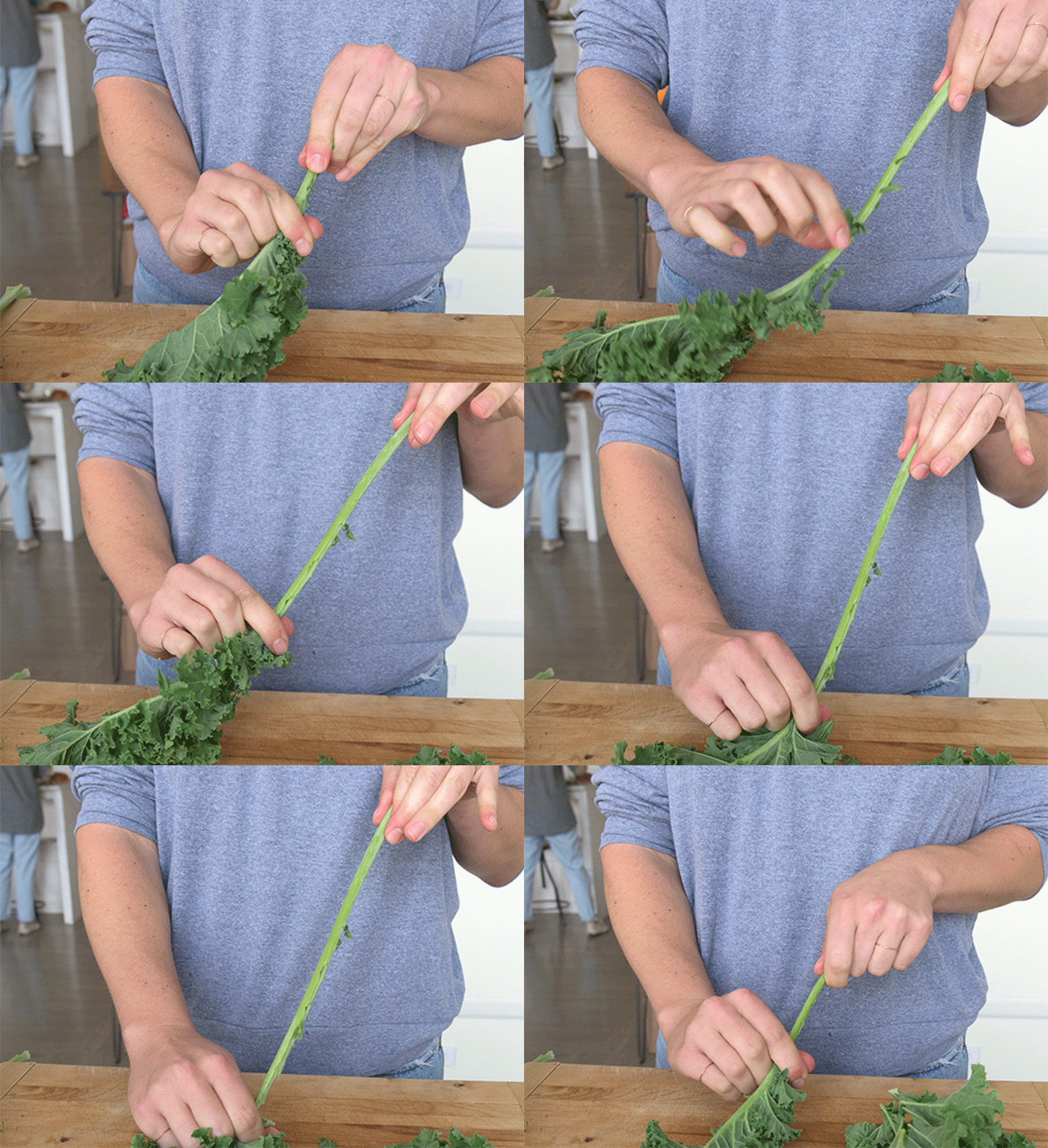
If you do use kale, be sure to use the fresh bunched kale, and not the pre-cut bagged kale. Bagged kale chops kale into pieces that includes the stem, which is not desirable for this recipe. If I’m being completely honest, kale stems don’t belong in any dish, except for making vegetable soup stock.

This is how to de-stem kale.

For a full-course meal, I’d serve it with a Fall Salad, Fudgy Brownies, and a bottle of sweet red wine.

Butternut Squash and Kale Orecchiette

  • Servings: 6 bowls
  • Difficulty: medium
  • Print


Choose the least curvy squash for easier handling. Substitute kale for other leafy greens if necessary.

Ingredients

  • 2 lb. Butternut Squash
  • 4-5 Kale Leaves
  • Half a Red Onion, diced
  • 2 Cloves of Garlic, minced
  • Half Can of Chicken Broth
  • 1 tsp Cumin
  • 1/2 tsp Nutmeg
  • 1 tsp Cayenne Pepper
  • Salt and Pepper to taste
  • 6 oz Orecchiette (half box)

Directions

  1. Preheat the oven to 350℉ and line a baking tray with greased foil.
  2. Wash, peel, cut the squash in half, remove the seeds, and cut the squash into cubes.
  3. Spread out half of the cubed squash onto the tray.  Bake in the middle-rack of the oven for about 30-45 minutes or until fully cooked. Set aside once done.
  4. Heat 2 tbsp of vegetable oil in a medium-sized skillet. Sauté the remaining half of the butternut squash.  Set aside.
  5. In the same skillet, heat another 2 tbsp of vegetable oil into the same skillet. Once heated, sauté the diced onions on medium to medium-low heat while constantly stirring for about 30 minutes or until the caramelized to your liking.  Set aside.
  6. In a large pot, add uncooked orecchiette and just enough water to cover the pasta. Add about a quarter can of chicken stock.  Once liquid boils, cook for the amount of time instructed on the packaging.  Stir constantly and add more chicken stock if the water level becomes too low. 
  7. Wash, de-stem, and cut kale into 2 inch pieces. In the last three minutes of boiling time, add kale with the pasta so they cook together.
  8. Strain the pasta and kale together. Return pasta and kale to the pot, add oven-roasted squash, sautéed squash, and caramelized onions.
  9. Turn the heat on medium and add seasonings to the pot: garlic, cumin, nutmeg, cayenne, salt, pepper. Toss pasta and seasonings together until homogeneous and taste is to your liking.


Fudgy Brownies (Updated)

Not to toot my own horn, but this is a really, really, good brownie recipe. I’ve gotten so many compliments on these brownies and most of my sweets recipients have become fans for these treats in particular.

Check out this gooey goodness! 😍

I must admit that this recipe is not completely my own- I encountered it on AllRecipes on one fine day. The original recipe calls for all vegetable oil, which I swap out for entirely melted unsalted butter. I also use cocoa powder instead of dutch-processed cocoa powder.

Since this recipe calls for a lot of oil, the estimated cost of this recipe is more pricey than my other recipes (roughly $4.83/tray). For comparison, I’ve found that a Betty Crocker brownie mix is $1.39 while a Ghiradelli “Double Chocolate” brownie mix is $1.99. However, I think this recipe tops any box mix, no matter how fancy (yeah, I’m looking at that Ghiradelli option), and is well worth the extra work and cash money.

Not feeling chocolate? What about…

Also, a perk of making your own brownies is that you can decide how “gooey” or well-done you want it to be. If you’re a fudge fan like me, bake for about 30 minutes and rest in the oven until the surface cracks (about 10 minutes). Alternatively, if you prefer a well-done brownie that resembles dense chocolate cake, bake for 40 minutes until the surface also cracks or a toothpick inserted in the middle can come out clean.

To spice things up a little, you can even add semi-sweet chocolate chips or toasted walnuts to the batter. I’ve tried both and they were delicious and make a great gift for the holidays!

I use a 6-inch square pan!

I think the most common size for square pans is 9-inches. Unfortunately, I do use a 6-inch pan for this recipe.

If all you have is a 9-inch pan, try doubling this recipe and altering the bake time to about 55 minutes and resting for 10 minutes. This timing is a rough estimate so I would also suggest following the pointer tips below:

Pointer tips:

After baking for 30 minutes (6-inch) or 55 minutes (9-inch), shake the pan. The center of the brownies should not be solid but should not be very jiggly either. It should barely jiggle.

Then, if a toothpick is inserted in the center, it should indicate that the batter has the consistency of chocolate ganache- like thick melted chocolate.

When the brownies has passed both of these conditions, turn off the oven but leave the brownies in the oven for an additional 10 minutes or until the surface cracks become more prominent.

Fudgy Brownies

  • Servings: 1, 6-inch square pan
  • Difficulty: too easy to resist
  • Print

These brownies are ooey-gooey like a lava cake!  Credit:  Mmm-Mmm Better Brownies


Ingredients

  • 1/2 C. Unsalted Butter, melted, at room temperature
  • 1 C. Granulated Sugar
  • 1 tsp. Vanilla Extract
  • 2 Large Eggs
  • 1/3 C. Cocoa Powder
  • 1/4 tsp. Salt
  • 1/2 C. All-Purpose Flour


Directions

  1. Preheat oven to 350℉.
  2. Grease a 6″ square pan.
  3. In a large bowl, blend together butter and sugar to get a grainy paste.
  4. Crack in the eggs and vanilla into the butter/sugar mix. Whisk until all ingredients blend together.
  5. In a smaller bowl, combine in cocoa, salt, and flour using a clean whisk to combine the ingredients.
  6. Add the dry ingredients to the larger bowl containing the wet ingredients in two parts. Fold with a rubber spatula in-between additions. Ensure everything is homogeneous.
  7. Pour the mixture into the prepared pan. Insert the pan into the middle rack of the oven.
  8. For fudgey brownies, bake for 30 minutes, and rest with the oven off for 10 minutes or until the surface cracks. The residual heat will finish off the brownie. For “well-done” brownies, bake for 40 minutes or until a toothpick inserted in the middle comes out clean.

To ensure maximum fudge goodness, I constantly check on my brownies while it’s cooling (or slowly cooking) in the oven. Since the brownie is using the leftover heat to finish, resist opening the oven door! Use the oven light to check if the surface has cracked.

Alternatively, once I notice that the sides and top looks cooked, I will open the oven door to jiggle the pan a little. The middle should still be very slightly jiggly for fudge brownies. If you are unsure whether you the brownie is done, inserting a toothpick in the middle is a great way to check how far along the brownie is. It should feel a bit like a chocolate ganache (not liquid, not solid either, but a creamy, dense chocolate).

Try adding semisweet chocolate chips or toasted walnuts to the batter for a lovely variation!