Fluffy Bread Loaf

Hello, hello, hello. It feels like it has been some time since I’ve sat still to write a blog post. I actually panicked internally when I realized just how fast June was passing by!

Despite only being halfway through, I think we can all agree that 2020 is an impactful year. It’s extremely difficult to summarize all the past and current 2020 events, but generally, all have seen disruptful changes that has forced people to re-examine the status quo.

*In America:

  • the COVID-19 pandemic is revealing the workings of government leadership;
  • health care and health insurances are legally able to discriminate against LGBTQ people
  • the anti-racist movement is in high gear;
  • people are fighting to reallocate police funding to social services instead;
  • and media biases are proving how businesses and money have the most influence in a capitalist system.

*I also recognize that there are pressing international issues such as in Yemen, Poland, Hong Kong, and Palestine.

In my personal life, 2020 has presented endless obstacles on top of the usual ones expected post-grad. After obtaining my B.A in December, I moved back home with my parents and tried to find my first big-girl job in the real world while trying to form some coherent life plans. The job search proved much more difficult than anticipated.

Things I wish I knew before graduating:

  • Beware of job scams, especially ones sent through email;
  • Be wary of sales jobs in the guise of a “marketing” job;
  • Be ready to commute upwards 30 miles;
  • An interview is not an interrogation but a two-way street;
  • Research pay rates for the industry to make sure you’re not under-paid;
  • Be ready to take in-person tests as part of the interview process;
  • Your university curriculum will not cover the practical knowledge desirable to employers so you’re responsible for your own learning afterwards. Invest in resources like LinkedIn learning, Google Academy, SkillShare, etc. and get certified if applicable!

Just when I thought I secured my first decent job, COVID-19 hit and my offer was rescinded on my supposed “first day of work.” It was a tough time-period and I wouldn’t wish the experience on anyone. I allowed myself to mope for a bit before gradually picking myself up but life would never be the same. Reality was hitting everyone hard.

Truthfully, I never thought that I would bring social and political issues onto my Instagram and blog since my initial vision was to foster a place of inspiration, positivity, and perhaps even of rest from the anxieties of the real world. Social and political issues hardly sparks happiness; however, 2020 has made rethink and call into question the use of my knowledge if I don’t do anything with it.

It’s been months now and while at home, I’ve been thinking more about my university discourses. I was a Communication Major and minored in Ethnic Studies briefly, so the current BLM movement exposing systemic oppression hit a lot of the topics I spent countless hours mulling over during undergrad.

With the knowledge that I already had, the movement’s voices became impossible to ignore and because I know very well of the importance of media’s application, I was convinced that not using my social platforms would be a moral crime. And thus…the “not so fun” COVID and BLM topics have made it into this recipe blog as well and I won’t apologize for it.

Some ways to aleviate some negativity in the world:

  • Wear a mask! COVID disproportionately affects Black people, Indigenous people, and People of Color (collectively abbreviated as BIPOC).
  • Support black businesses. Supporting local black businesses is even better. How you choose to spend your money matters because money is power and the act of ‘buying’ means approval. That said, give power to those that need it and have been slept on essentially forever.
  • Sign petitions! Call and email your government representatives if you can. Also, make sure you’re registered to vote if you’re able. BTW, a third of the states allow those who are 17 but will be 18 by the general election to vote in primaries.
  • Donate if you’re able. Consider donating to smaller organizations like MPJI or The Loveland Foundation.
  • Download an app called “Free Rice” to help feed countries in need (i.e. Yemen). You can donate as well, but I think “Free Rice” is a more sustainable action.
  • Make baby steps towards sustainability. Systemic racism and environmental justice go hand in hand. BIPOC communities take the brunt of environmental hazards. A more detailed explanation here.
  • Normalize changing opinions.

Anyways, during quarantine, I, alongside many of my foodie peers, have been baking a lot. Especially bread. But while it seemed that most people were caught up on making Sourdough bread, I was making Milk Bread by Kirby’s Cravings, who was inspired by Christine’s Recipes!

Fluffy Bread Loaf

  • Servings: 1 Loaf
  • Difficulty: Intermediate
  • Print

Ingredients

  • ~5 Cups Bread Flour
  • 4 Tbsp Brown Sugar
  • 1 tsp Salt
  • 1 Cup Milk
  • Tangzhong (1/3 cup Bread Flour with 1 Cup Water)
  • Yeast (2 tsp Yeast, 1/2 Cup Warm Water, 1/2 Tbsp Brown Sugar)

Directions

  1. See directions by Kirby’s Cravings.


If kneading dough by hand, expect to be kneading upwards an hour. When ihe dough is kneaded enough, the dough will not be as sticky and will form a ball on its own. If you pinch a piece of the dough and stretch it outwards, a hole will slowly form in the middle of the stretched out portion.

Use 1 beaten Egg White to brush the tops of the bread before baking. Bake at 325°F for 30 minutes or until golden brown.


Black Sesame Tarts with Ube Custard Filling

Shout out to my friends “Chef Ramsey’s Right Hand Pan,” “All Might,” and “Chickpea” for helping me come up with a title!

Names suggested: tarts de la custard ubé, sesame street tarts, ube custard me me tarts, and ube bae bae.

What’s Ube?

If you’re unfamiliar with ube, it’s a yam that’s purple on the inside but a lot sweeter than your average yam! Some people mistake it for taro, but taro, while also delicious, is not a yam to say the least.

Ube is also known for its rich purple color and while taro can also be purple (or white), it’s a lighter shade than ube. Because of it’s intense purple color, ube-flavored foods like breads or lattes are visually captivating.

For example:

Around 2015 in California, ube sweets were trending in California and prompted many ube-oriented sweets shops to open in LA. Although I live in a suburb of LA, I’ve never had the opportunity to visit one of these stores.

Flash forward five years, and having the time, motivation, and adequate knowledge, I decided to create my own ube treat instead of making the trip to LA (not that I could during the quarantine anyways). I decided on a tart theme.

Initially, I imagined making an ube cheese tart or ube mochi tart. Unfortunately, I didn’t have cream cheese on hand to make a cheese tart and while I was very tempted to make a mochi tart, I wasn’t sure how successful my endeavor would be. Thus, I settled with a custard tart.

No Tart Tin? That’s Okay!

There was one small problem with making tarts ⁠— I didn’t have tart tins so I had to use cupcake tins and a 5-inch cookie cutter. You’ll soon see that it turned out to be hardly a problem at all.

Ended up trading this 3″ cutout shape for a 5″ flower shape to better fit the tin

I cut some parchment paper rounds to line the bottom of the tins, but I found that it would probably be fine without since there’s so much butter in the dough.

Since I wasn’t too confident in making a tart shell, I did a small batch of tart shells first as a trial run though. For the sake of science, here were the ingredients I used:

Trial 1 – Crust was too thick!

  • 5 Tbsp Unsalted Butter
  • 1 Large Egg White
  • 2 Tbsp Sugar
  • 13 Tbsp Flour (or 1/2 Cup + 5 Tbsp)

Crust was too thick at a quarter inch!

The result was a tart that was kind of chewy but also kind of dry. I think it tasted dry because I didn’t roll out the dough as thin as I should’ve. Regardless of the thickness, I felt that this wasn’t the kind of crust that I wanted. I envisioned something more crisp and delicate, not chewy.

After I eating the tarts with the ube custard, I also felt that there was a certain depth missing. I started to think that adding black sesame’s earthy and aromatic flavor profile might help…so I did just that for trial #2.

Added one plain tart (rolled out thinner) for flavor and texture comparison

Except that while I usually have plain black sesame powder on hand, I didn’t this time. I did have instant black sesame powder paste though ⁠— the kind that makes instant black sesame dessert soup. I decided to use it anyways because it claimed that it was low sugar anyways, so I took a chance that it would work.

If you use plain black sesame powder (not for instant dessert soup), try substituting with roughly 6 Tbsp black sesame powder and 1 Tbsp sugar.

Anyways, I modified the first tart recipe as follows:

Trial 2 – Winner!

  • omit sugar since the instant black sesame powder already has sugar
  • add cornstarch for a more delicate pastry
  • use less flour to account for flour needed for dusting
  • roll out the dough thinner (about an eighth of an inch thick)
Blind baking shells: poke holes on the bottom and sides with a fork, line with parchment paper, and top with pie weights (I used dried red beans)

I couldn’t be happier with this trial’s results! The pastry was delicate yet crisp, and the black sesame perfectly complemented the ube custard and brought out a “natural” ube flavor.

On another note, I’m so glad that the ube custard set after baking. It was one of my main concerns going into this project but it turned out alright the first time around so I focused on the tart shells instead.

Ube custard darkens at the top after baking. I also suggest smoothing out the custard before baking (which I didn’t do!)

Without further ado, here are the recipes for the ube custard and black sesame tarts:

Ube Custard

  • Servings: enough to fill 12 tarts
  • Difficulty: easy
  • Print

Ingredients

  • roughly 1 and 1/2 Cups Steamed Ube, mashed
  • 1/2 Cup milk
  • 2 Tbsp condensed milk
  • 1 Tbsp sugar
  • 3 egg yolks

Directions

  1. Combine all the ingredients except the egg yolks in a saucepan. Heat over medium-low heat and stir continuously until the mixture is as smooth as possible. Some small chunks of ube are ok. Turn off the heat and let cool for 10 minutes.
  2. Transfer the mixture to a blender and blend until completely smooth. Transfer back to the saucepan.
  3. Beat the 3 egg yolks together in a small bowl. Add two tablespoons of the ube mixture to the eggs and mix to temper them. Add the tempered egg-ube mixture into the pot.
  4. Whisking continuously over medium-low heat, heat the custard becomes very thick (should be able to hold shape even when it’s hot). Turn off the heat.
  5. Pass the mixture through a sieve and let it cool. Cover the custard with plastic wrap directly touching the custard. Store in the fridge until needed.

Sesame Tart Dough

  • Servings: 7 tarts using cupcake tins
  • Difficulty: easy
  • Print

Ingredients

  • 5 Tbsp Unsalted Butter, room temperature
  • 1 Large Egg White
  • 2/3 Pack Sesame Powder Paste (Torto brand)*
  • 3 Tbsp Cornstarch
  • 1/2 Cup + 1 Tbsp Flour
  • 1 Tbsp Flour mixed with leftover sesame powder (for dusting)

Directions

  1. Combine all the ingredients together in a bowl until it becomes a cohesive ball. Roll out dough between two sheets of plastic wrap until it is around a quarter inch thick.
  2. Chill the dough in the fridge for at least 3 hours. Meanwhile, cut out parchment paper rounds to line the bottoms of the cupcake molds.
  3. Sprinkle a work surface with a bit of flour and sesame powder and roll out the dough to an eight-inch thickness. Dust the top of the dough with flour/sesame as needed to prevent sticking.
  4. Use a 5″ cookie cutter to cut out 7 tarts. Place cutouts into the cupcake molds.
  5. Prick holes at the bottom and sides of the tarts with a fork. Place a small square of parchment paper on top of the the tarts and place pie weights on top. The parchment paper makes it easier to remove pie weights onced baked.
  6. Blind bake the tarts at 375°F for 7 minutes. Rotate the pan halfway through baking to ensure even baking.
  7. Take tarts out of the oven and allow tarts to cool for at least 5 minutes. Remove pie weights and parchment paper squares.

*If you use plain black sesame powder, try substituting with roughly 6 Tbsp black sesame powder and 1 Tbsp sugar.

Black Sesame Tarts with Ube Custard Filling


Ingredients

  • Half of the Ube Custard
  • 7 blind-baked Sesame Tarts

Directions

  1. Fill each tart shell with roughly a tablespoon and a half to 2 tablespoons of ube custard. Smooth out the tops of the custard.
  2. Bake tarts at 350°F for 20 minutes in the middle-rack of the oven or until the tops of the custard forms a skin. Turn off the oven but let the tarts rest inside for an additional 7-10 minutes or until tart crusts brown to your liking.
  3. Cool tarts at room temperature for at least 5 minutes before serving.

Colorful Vegetarian Kimbap

My parents hauled stacks of Korean seaweed home from their trip in Korea!

Three packs of three different seasoned seaweed, PLUS the seaweed sheets that have been sitting the pantry for far longer than it should be.

I have yet to try all three flavors yet, but they are certainly tasty! I would eat them by themselves or with plain rice, and yet, it still seemed like we had an endless supply of seaweed. I felt bad for the older seaweed in the pantry that would mostly likely continue to be neglected in favor of the newer products…so I decided to make kimbap with both the old and new seaweeds.

It’s not really right to call this a recipe since everything is so customizable, but I’ll try to give some pointers!

If you’re looking for a recipe, check out my other Korean-inspired recipe:

Ingredients

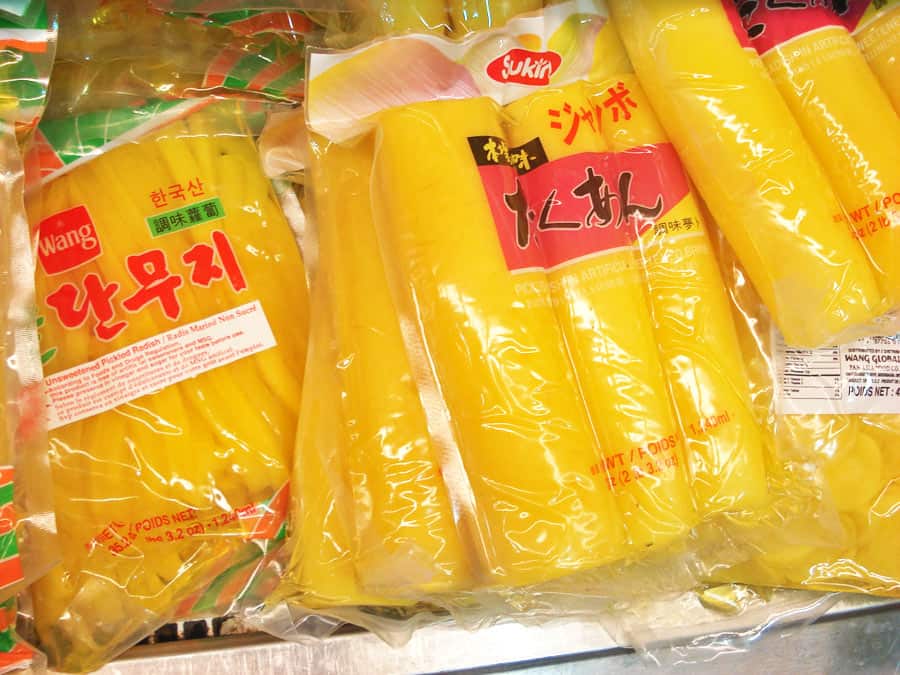
Most kimbap includes meat and vegetables. The meat could be anywhere from expensive marinated beef or mystery spam. Vegetables could also be whatever is available, but almost every kimbap has danmuji, or pickled radish, within the mix. Ideally, kimbap is colorful, so the vegetable choices reflect that, but I wouldn’t say that you must make kimbap colorful if you don’t care or can’t afford to.

“Danmuji” or pickled radish

I’m not vegetarian, but I’m averse to cooking raw meat and am not fond of canned meat, so I opted for imitation crab and fried egg for my “meat” choices. Some other vegetarian options could also be marinated tofu or tempeh, or you can choose to opt out of “meat” entirely.

For my veggies, I chose to use: spinach, cucumber, carrot, and kimchi, and danmuji. I don’t think kimchi is common in kimbap, but I thought that I would add it in to complement the pickly-sour taste of the danmuji.

Again, you patrol what you put in your roll. So, stick to ingredients you’re comfortable with! That is the beauty of customizable kimbap!

I cooked about one cup of rice for about 3 rolls. After the rice was done, I mixed in some salt, sesame oil, and a little bit of rice vinegar for flavor. Then, I set it aside to cool to room temperature. Meanwhile, I was chopping and slicing all the ingredients into strips.

Ingredients on stand-by, including my plain seaweed and new seaweed.

I used a bamboo mat to shape my kimbap rolls. Using a bamboo mat helps make the wraps as tight as possible without squishing it too much, but it’s possible to make rolls without it using plastic or cling wrap. It might be slightly more difficult to control though.

Over a stovetop on medium-flame, I quickly swiped my plain seaweed sheets across a couple times to “roast” it. I left the seasoned seaweed as is.

Making Rolls

On the bamboo mat, I placed a sheet of plain, now roasted, seaweed flat, shiny side down. I covered the non-shiny side of the seaweed sparsely with rice. You really don’t need a lot of rice. There could be tiny gaps of rice, but I promise it’ll be fine! The hardest thing about kimbap or sushi is avoiding adding too much rice. I wet my fingertips with water before spreading the rice around. The water prevents the rice from sticking to your fingers.

Afterwards, I arrange the fillings horizontally, about 3 inches away from the edge facing you, in no particular order. Then, I lift the edge of the bamboo mat nearest me and try my best to cover all the ingredients. Squeeze everything together gently, and put the bamboo mat back down. The seaweed, rice, and kimbap fillings should stick together. Proceed to continue rolling the rest of the rice/seaweed flap. Then, use the bamboo mat to squeeze everything into a roll-shape again. Repeat with remaining rolls and ingredients.

I realize it’s difficult to explain “how to roll” without visuals (I couldn’t take pictures with dirty hands), so here’s a helpful video from my favorite Korean homecook that I’ve learned lot from:

This step is optional, but I like to brush some sesame oil on the outside rolls before cutting them up.

Greener colored roll (right) is made with the seasoned seaweed my parents brought from Korea.

Seasoned or Unseasoned?

I do think that the kimbap using seasoned seaweed had that extra flavor punch that made it slightly better than plain seaweed, but I think as long as you season the fillings well, it should make up for the lack of flavor outside. I made the mistake of undersalting the rice and fried egg, so my kimbap was pretty plain, but still delicious!

I like to add extra slices of danmuji on top of each bite- yummy!!!

Sweet Potato / Ube Latte

A couple of years ago, I heard that sweet potato lattes were popular in Korea. While making a drink out of potatoes may seem strange, I think it’s one of those uncalled for inventions that no one knew they needed until it existed. It’s the perfect drink during the colder months– because the latte base is sweet potato, the latte is thicker than other flavored lattes, say, a green tea latte, which means that this drink fills you up and retains its heat much better. Additionally, since sweet potatoes are sweet by themselves, you don’t have to add much sugar to the drink, making it a relatively healthy treat!

Another “healthy” treat:

Avocado Smoothie

Avocados contain four grams of protein, making them the fruit with the highest protein content!

That said, I chose to use purple sweet potato (aka ube) this time instead of regular sweet potato. Since the purple coloring is pretty, I also decided to try to do a layered effect and make it a bit fancier than the normal sweet potato latte.

I’d imagine that any other sweet potato variety would also work for this, but keep in mind that the sugar levels differ depending on the type of potato, so adjust the recipe as needed.

Since I’m doing a layered effect, I separated the latte into three parts with the densest layer on the bottom: paste, milk, and whipped cream respectively.

If you want to re-create this recipe normally and don’t care for appearance, go ahead and blend the paste and all the milk together. This is what I usually do with normal sweet potato latte.

Unfortunately, I would also like to be able to have pretty milk foam floating at the top, but I haven’t found a successful way to froth milk without a milk-frother yet. If you know how to froth milk, by all means, do it!

3-Layer Ube Latte

  • Servings: 1 cup
  • Difficulty: easy
  • Print


Use whatever milk you prefer.

Ingredients

  • 1 small Purple Sweet Potato, steamed and peeled
  • 1 Cup hot Almond Milk
  • 2 Tbsp Condensed Milk
  • Whipped Cream for topping
  • Chopped Walnuts for topping (optional)

Directions

  1. In a blender, combine the small purple sweet potato, 1/4 Cup of almond milk, and 2 Tbsp condensed milk. Blend until smooth. Strain mixture if needed. Pour mixture into the bottom of a mug.
  2. Slowly and carefully add hot milk on top of the sweet potato paste.
  3. Top with whipped cream and walnuts, if desired.

Sweet Potato Latte

  • Servings: 1 cup
  • Difficulty: easy
  • Print


Use whatever milk you prefer.

Ingredients

  • 1 small Sweet Potato, steamed and peeled
  • 1 Cup hot Almond Milk
  • 2 Tbsp Condensed Milk
  • 4 Walnut Halves, chopped
  • Whipped Cream (optional)

Directions

  1. In a blender, combine the sweet potato, 1 Cup of almond milk, 2 Tbsp condensed milk, and 4 walnut halves. Blend until smooth. Strain mixture if needed.
  2. Pour mixture into a mug. Top with whipped cream and more walnuts, if desired.

By the way, I got my pretty glass mug from Ikea! 😊

Christmas Box Cookies

Usually, I would use my adapted sablé cookies recipe from linuxhacker since I’ve already made so many variations of it; however, I came across a cookie box recipe on YouTube and wanted to try it out after reading all the positive comments.

I went ahead and decided to make 5 different varieties using half the recipe: cranberry-orange, chocolate chip, classic chocolate and vanilla, strawberry-jam linzer, and holiday gingerbread.

Unlike the old recipe I usually used for these kinds of cookies, this recipe used raw eggs. This saved me some time since I used have to boil and grate the yolks of boiled eggs in the old recipe.

Heart-stamped strawberry-jam cookies, leaf-shaped “gingerbread” cookies, orange-cranberry, and chocolate chip cookies.

In the video, Emma stacked two cookies to make the jam-centered cookies. I chose the lazy route and stamped some hearts into cut cookies instead and fill the indentation with jam. It still worked 😆 but the jam didn’t fill as cleanly as if I were to cut and stack two cookies together.

Emma also made gingerbread flavored cookies in her video. She used a little bit of cocoa powder to add color to the gingerbread flavored cookies. I thought this was a great idea, so I also did the same. However, I didn’t have ginger powder nor cloves, so I used a bit of pumpkin spice mix with some extra cinnamon powder. I don’t recommend doing this for a true gingerbread flavor since mine tasted predominately cinnamon-y.

Overall, it was a great recipe, and my mom even thought it was better (cause it was softer) than my adapted recipe from linuxhacker. Personally, I couldn’t really tell since they were both delicious! Anywho, thank you Emma, for sharing your wonderfully versatile recipe– it’s definitely a keeper!

DIYed some cookie boxes to give away the cookies to my friends.

Other cookie recipes:

Turtle-Shaped Cookies

Did you know turtles date back to the time of the dinosaurs, over 200 million years ago?

Fruity-Poppin’ Cookies

Once again, I made a variation of sablé cookies using only the vanilla portion of the recipe. I made lemon, “cherry,” and “strawberry” shaped cookies to give away as thank you presents.

The red parts (“cherry” and “strawberry”) were made with red gel food coloring and roughly chopped dried cranberries. The green parts were colored and flavored with only matcha powder (too much matcha powder creates a bitter flavor, so substitute with some green gel food coloring if this bothers you). The yellow in the lemon shaped cookies were colored with yellow gel food coloring and flavored with lemon zest!

Note: I would like to use all-natural food dyes, but I didn’t have any on hand (except for green matcha) so I had to use gel coloring. Use whatever dyes you prefer!

The “strawberry” and “cherry” cookies were free-form, meaning I shaped each one of them by hand- the bodies and the stems! Armed with the red and green dough, a lined cookie tray, and a good TV show (like The Bold Type), I went to work. All the while, the checkerboard shaped cookies and the cylindrical lemon cookies (encased in a paper towel roll with a slit lengthwise) were chilling in the freezer.

I highly recommend watching The Bold Type for some womanly empowerment!

By the time I had finished shaping a satisfactory amount of cherries and strawberries, the cookies in the freezer were hard enough to slice. I cut up some checkerboard and lemon cookies into 1/4 inch slices and added them to the empty spaces of the cookie tray.

Once again, I baked the tray at 350°F for about 7 minutes or just until the edges begin to brown.

Finally, I made a quick icing with milk and powdered sugar to pipe on the strawberry seed and lemon wedges.

It is honestly a tedious process but so worth it for all the smiles you get when you give them away ❤