Kale and Potato Hash (Updated)

Do you ever just have leftover kale…maybe from making Kale and Butternut Squash Orecchiette?

Shameless plug aside, I’m honestly not the biggest fan of kale. I know that my previous statement is contradictory since I now have two published recipes with kale as a main ingredient- but, you have to admit that when kale is stir-fried with garlic and other veggies, it transforms into savory goodness. If you’ve yet to experience the formidable flavor pairing that is kale and garlic, I commend you to try out this recipe!

I think that the key to making kale appetizing is to de-stem it. I once bought bagged kale on accident and was appalled to find that kale from the bag came with their stems on. Some people do eat kale with the stems, but I can’t seem to bring myself to enjoy the stem part even after pan-frying it with heaps of garlic.

Since finding ways to make kale taste good, kale has become a staple in my fridge. I’m also glad that it’s a pretty cheap vegetable at 99¢a bunch during the spring and summer. Somehow, its presence in the fridge is also a reminder to feed my body healthier food.
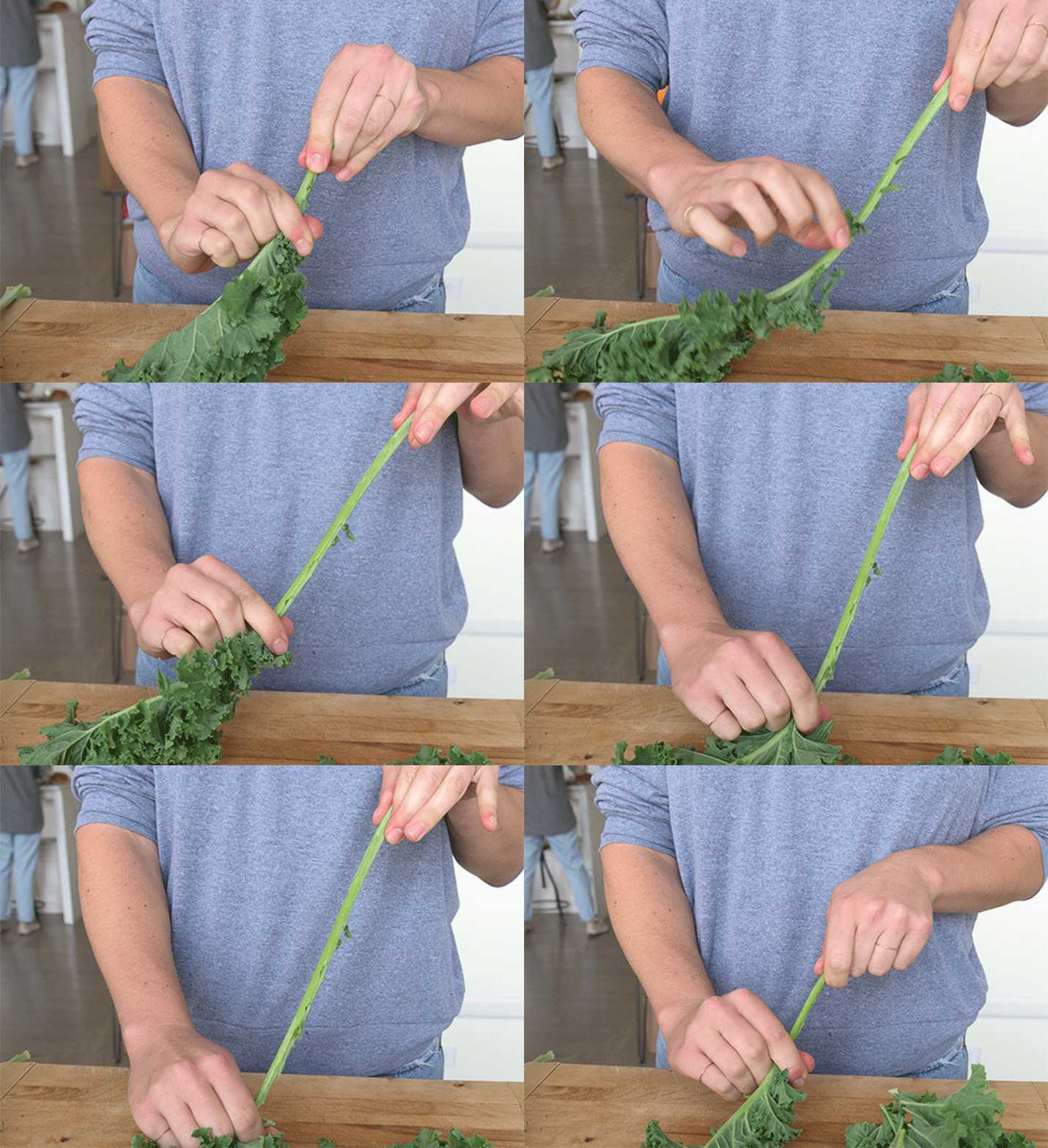
Be sure to thoroughly wash and de-stem your kale leaves. You can either use a knife to cut around the stem, or slide the leafy part off like so:

I love this breakfast idea because it’s hearty and healthy. So, if I have time and leftover kale, chances are, I’ll be making this for brunch. Plus, it’s a breakfast idea that doesn’t have spinach for once. Nothing against spinach, but variety is very welcome in my kitchen. Then again, if you would like to substitute kale for spinach, go for it. Speaking of substitutions, sweet potato hash instead of potato would also be yummy too.

Rinse off the starches for a crispier hash.

Whatever your choice of starch, be sure to rinse the chopped cubes in a bowl of water a couple times to remove the starch on the outside. Then, pat dry the cubes as much as possible. Removing the starch and drying them will help the cubes fry up faster and more evenly.

After cooking, I recommend serving it in a big bowl fit for a hearty meal. I love my breakfasts in bowls because it makes it easy to consume by the spoonful- real classy, I know- but such a simple thing makes me feel so free and happy. So, I’m going to recommend that you serve this in a bowl too. Thank me later.

Feeling something sweet instead? Try this:

Kale and Potato Hash

  • Servings: 2 bowls
  • Difficulty: easy
  • Print

Ingredients

  • 3-4 Kale Leaves, de-stemmed and cut into 1″ pieces
  • 1 large Russet Potato, cubed, rinsed, and dried
  • 2 Garlic Cloves, minced
  • 1 tsp Cayenne Pepper
  • 2 Eggs
  • 2 Tbsp Vegetable Oil
  • 1/4 Cup Water
  • Salt and Pepper to taste

Directions

  1. In a large skillet, infuse the garlic in vegetable oil by heating together over medium-low heat until fragrant.
  2. Add the potatoes, and crank up the heat up to medium-high. Let the potatoes sit untouched until the bottom begins to crisp and brown, about 3 minutes. Flip the potatoes and allow the other sides to crisp and brown as well until all sides are nicely browned.
  3. Add kale, cayenne pepper, salt and pepper, and water. Put a lid over the pan and let everything cook for about 5 minutes or until kale is cooked.
  4. In a small frying pan, make sunny-side up eggs to top the hash with.
  5. After cooking the hash for 5 minutes, open the lid and continue to cook to evaporate any excess water.
  6. Serve hash in a bowl and top with a sunny-side up egg.

  • Substitute kale with spinach and/or potato with sweet potato.
  • Make scrambled eggs instead of a sunny-side up egg and mix it into the hash.
  • When eating the hash with a sunny-side up egg, break the yolk and mix it with the hash for a creamy texture.

While I was writing this updated recipe and looking over the old version, I got a bit emotional at the note I had written at the bottom of the old recipe.

I initially published this recipe on March 17, 2019, almost a complete year ago. I had written that I was proud of how far I had come since the thought of making a cooking blog back in November 2017. Now, in February 2020, I’m in disbelief that blogging has been with me for this long, granted I wasn’t regularly updating until January 2019 when I moved the blog here on WordPress. Regardless, I am still proud of myself for sticking with this blogging thing.

In the old post, I also wrote about starting an Instagram account. Not to keep tooting my own horn, but yeah, I did that and I’m doing pretty good!

Once again, I am so thankful for my friends, family, and other online supporters that continue to motivate me to keep going!

Original note left at the end of the old recipe post

As always, let me know if you’ve tried out this recipe! I’d love to know how it goes.

Soft Snickerdoodle Cookies (Updated)

These are by far the softest and fluffiest cookies I have ever had. Ever. And so, like any amazing recipe, I had to share it and make sure it never disappears. The original recipe is from Mrs. Sigg’s.

The trick to these cookies is to make them by hand because it is easier to overwork the dough using electronic machines, thus, ruining the texture of the cookie. However, if you must break out the hand-mixer or stand-mixer, be sure to be wary about overworking the dough. Stop mixing immediately once the ingredients are homogeneous.

The perfect homemade treat with some tea.

I use an ice cream scoop to make the cookie sizes relatively even, but if you have a cookie scoop, that’s even better!

Since these cookies are really soft, it’s important to let the cookies rest after baking. Although it’s hard to resist oven-fresh cookies, these cookies will be too soft to handle fresh. Letting them cool will help the cookies harden slightly.

The total cost of a whole tray of medium-sized cookies for me was roughly $2.95.

Want something chocolate-y instead?

Fudgy Brownies (Updated)

Crispy top and melt-in-your-mouth interior…what other reason do you need to make these brownies?

Soft Snickerdoodle Cookies

  • Servings: 12, 3-inch cookies
  • Difficulty: easy
  • Print

Credit:  Mrs. Sigg’s. It’s very important to use room temperature unsalted butter in this recipe.

Ingredients

  • 8 Tbsp Unsalted Butter, at room temperature
  • 3/4 C. Sugar
  • 1 tsp Vanilla Extract
  • 1 Tbsp Cinnamon
  • 1 Large Egg, beaten
  • Roughly 1+1/3 Cup of Flour
  • 3 tsp Baking Powder
  • Cinnamon Sugar (3 Tbsp Cinnamon + 3 Tbsp Sugar)
  • Cooking Spray

Directions

  1. Whip butter until creamy. Add sugar, cinnamon, and vanilla. Mix until ingredients are all combined.
  2. Add in the beaten egg, and mix until combined.
  3. In a separate bowl, sift the flour and baking powder together. After sifting, add the dry ingredients into the wet ingredients. Fold wet and dry ingredients together with a rubber spatula until just combined.
  4. Preheat the oven to 400 degrees Fahrenheit. Line a cookie tray with parchment paper and grease with cooking spray.
  5. Use an ice cream scoop to portion the cookie dough into about 12 cookies.  With our hands, shape portions into balls.
  6. Coat the surface of the ball in cinnamon sugar by rolling the ball in a small bowl with cinnamon sugar. Place the coated dough balls onto the tray, allowing at least an inch of space around each cookie.
  7. Bake in the oven for 8 minutes or until edges start to brown. Allow cookies to rest at room temperature for at least 10 minutes before serving.

Warm up cookies older than a day by baking at 350°F for about 4 minutes.


Big thanks to my roommate who actually tests out my recipes. There are a lot of components of a recipe’s success that I am ignorant of until she lets me know. It is only because of this that I am able to edit and improve my recipes so I am incredibly grateful.

In the older version of this recipe, I was open about the fact that I had used salted butter with success for this recipe. It didn’t occur to me that I should’ve included a word of caution about selecting fats for cookies.

Generally speaking, I find that for cookie recipes, it is mandatory to use unsalted butter if that’s what it calls for. In desperate times, I have used salted butter before; however, I do not recommend it if it can be helped. It may seem obvious, but the salt in salted butter can mess up a cookie’s texture because salt produces moisture in the cookie dough when it bakes. It’s not an extreme difference though, which is why I was able to get away with it in this case. The consequences of substituting salted butter in more delicate cookie recipes could be way worse though.

It should be noted that some recipes call for salt even if unsalted butter is being used but this still doesn’t mean that using salted butter is okay. The salt added with unsalted butter is miles less than the amount in salted butter. That said, in my case where I used salted butter desperately, I would’ve skipped any additions of salt the recipe called for to minimize damage.

Other evil substitutions for unsalted butter include margarine, stick-version of vegetable oil, and liquid oils. Not only do these fats secrete unwanted moisture, but they also have a different melting temperature than what is desired in unsalted butter.

Good luck in the kitchen, and please do let me know your results if you try out any of my recipes!! ❤👩‍🍳

Butternut Squash Orecchiette (Updated)

Making this dish is no easy feat, but don’t let that discourage you from making it! This pasta dish is easily a crowd pleaser. It’s fun to eat because of the orecchiette and has a deep flavor profile.

Orecchiette pasta is “ear-shaped”!

In my experience, it has successfully satisfied both my parents, attendees at a pot-luck, my roommate, and my roommate’s aunts and uncles. This pasta is also great for the Fall season when squashes are almost always in abundance and on sale at the markets.

That said, this pasta dish demands a lot of preparation time. To make the process easier, I recommend that you choose the straightest, non-curvy, butternut squash possible so that it is easier to handle.

Pressed for time? Try this pasta option:

Honestly, the hardest part of this recipe is dealing with the butternut squash. When I made this recipe for the first time, I struggled since I never handled a hard squash before. I’ve made this pasta many times since then, and I can assure you that practice makes a world of difference!

For more tips on how to prepare butternut squash, check out Tori Avey‘s blog post.

I’d also like to take the time to point out that I do use kale in this pasta. I realize that many people don’t like kale, but I promise that the cooked kale in this recipe does not have a strong flavor. Most of the people that have eaten this pasta have never tried kale or typically don’t like leafy greens, and yet have told me afterwards that they didn’t mind the kale in the pasta. So please, give kale a chance! Otherwise, other leafy greens like spinach are also a good substitute.

If you do use kale, be sure to use the fresh bunched kale, and not the pre-cut bagged kale. Bagged kale chops kale into pieces that includes the stem, which is not desirable for this recipe. If I’m being completely honest, kale stems don’t belong in any dish, except for making vegetable soup stock.

This is how to de-stem kale.

For a full-course meal, I’d serve it with a Fall Salad, Fudgy Brownies, and a bottle of sweet red wine.

Butternut Squash and Kale Orecchiette

  • Servings: 6 bowls
  • Difficulty: medium
  • Print


Choose the least curvy squash for easier handling. Substitute kale for other leafy greens if necessary.

Ingredients

  • 2 lb. Butternut Squash
  • 4-5 Kale Leaves
  • Half a Red Onion, diced
  • 2 Cloves of Garlic, minced
  • Half Can of Chicken Broth
  • 1 tsp Cumin
  • 1/2 tsp Nutmeg
  • 1 tsp Cayenne Pepper
  • Salt and Pepper to taste
  • 6 oz Orecchiette (half box)

Directions

  1. Preheat the oven to 350℉ and line a baking tray with greased foil.
  2. Wash, peel, cut the squash in half, remove the seeds, and cut the squash into cubes.
  3. Spread out half of the cubed squash onto the tray.  Bake in the middle-rack of the oven for about 30-45 minutes or until fully cooked. Set aside once done.
  4. Heat 2 tbsp of vegetable oil in a medium-sized skillet. Sauté the remaining half of the butternut squash.  Set aside.
  5. In the same skillet, heat another 2 tbsp of vegetable oil into the same skillet. Once heated, sauté the diced onions on medium to medium-low heat while constantly stirring for about 30 minutes or until the caramelized to your liking.  Set aside.
  6. In a large pot, add uncooked orecchiette and just enough water to cover the pasta. Add about a quarter can of chicken stock.  Once liquid boils, cook for the amount of time instructed on the packaging.  Stir constantly and add more chicken stock if the water level becomes too low. 
  7. Wash, de-stem, and cut kale into 2 inch pieces. In the last three minutes of boiling time, add kale with the pasta so they cook together.
  8. Strain the pasta and kale together. Return pasta and kale to the pot, add oven-roasted squash, sautéed squash, and caramelized onions.
  9. Turn the heat on medium and add seasonings to the pot: garlic, cumin, nutmeg, cayenne, salt, pepper. Toss pasta and seasonings together until homogeneous and taste is to your liking.


One Wok Japchae

There were two motivations in making this recipe- the first, as always, was due to the fact that I was craving japchae but didn’t have immediate access to any Korean restaurant. The second motivation stemmed from my own guilt that the bag of glass noodles or sweet potato noodles that I had bought more than two months ago went neglected for as long as it did.

Perhaps you are unable to relate to my motivations stated above, but hopefully, you have landed yourself on this blog post because you at least love or are interested in learning how to make japchae with limited time and effort. If so, you’ve come to the right place.

As the title suggests, this recipe requires one wok, or a really big skillet. I would not consider this recipe traditional by any means since it skips a lot of steps (mainly parboiling the different vegetables separately), but the end result, in my opinion, is just as satisfying. Also, because this recipe is all done in one wok, it requires less oil than it’s traditional counterpart in which sesame oil would be added not only to the noodles, but to each different vegetable category as well.

I did not include any meat in this recipe because I don’t like cooking meat, but feel free to add your own spin with meat if you’d like.

I love meal prepping japchae because it can be eaten both hot or cold- which means that I can eat without worrying about finding a microwave between classes.

One Wok Japchae

  • Servings: 2
  • Difficulty: easy
  • Print

Ingredients

  • 3 tbsp vegetable oil
  • 4 tbsp sesame oil
  • 4 tbsp soy sauce
  • 2 tbsp brown sugar
  • black pepper
  • salt
  • 1 tbsp Korean red chili powder
  • 2 tbsp garlic, minced
  • 5, 2-inch stalks of green onion
  • 1/4 white onion, thinly sliced
  • 2 small carrots, thinly sliced
  • 5 re-hydrated shiitake mushrooms, thinly sliced
  • handful of spinach
  • 1 large egg
  • 3 Cups of water
  • glass noodles
  • sesame seeds (optional)

Directions

  1. Marinate the shiitake mushrooms: in a bowl, add mushrooms, 1 tbsp soy sauce, 1/2 tbsp sesame oil, 1 tbsp brown sugar, 1 tsp garlic and 1/2 tbsp red chili powder. Mix and set aside for about 15-20 minutes.
  2. In a medium-sized wok, heat up 1 tbsp of vegetable oil. Sauté carrots on medium-high until cooked. Season with salt. Set aside on a designated “prep” plate.
  3. Return the wok to medium-high heat. Cook the marinated mushrooms until marinade is absorbed and mushrooms are cooked, about 3 minutes. Set mushrooms aside on “prep” plate.
  4. The wok should still be hot, so there’s no need to turn the heat back on. Quickly add spinach and a dash of soy sauce and sauté until just barely cooked, about 1 minute. Set aside on “prep” plate.
  5. Add another tbsp of vegetable oil in the wok. Add in the green onions. Sauté on high until fragrant.
  6. Add onions and 1 tbsp of garlic to the wok and cook on medium with the green onions until onions start to become translucent. Set aside on “prep” plate.
  7. Boil water in the wok. When it boils, add the glass noodles and cook for 2 minutes or according to the time on the packaging.
  8. Strain the noodles under cold, running water. Add sesame oil to keep the noodles from sticking to each other. Set aside.
  9. Add 1 tbsp of oil to the wok and set it on low. To separate the egg white from the yolk, barely crack the egg on the kitchen counter and, using your fingers, gently pry the shell apart over the wok. Let the egg whites drip onto the wok, being careful not to puncture the egg yolk. Set the egg yolk aside in a small bowl.
  10. Cook the egg white with the lowest heat possible. When cooked, set aside.
  11. Remove the white parts from the egg yolk, then beat the egg yolk until smooth.
  12. Cook the egg yolk on the lowest heat possible. When cooked, set aside.
  13. Slice the cooked egg white and yolk into thin strips, set aside on the “prep” plate.
  14. Add 1 tbsp to the wok and 1 tbsp of garlic to the wok. Set on medium heat. When the garlic is fragrant, add the glass noodles back to the wok. Add 2 tbsp soy sauce, 1 tbsp brown sugar, some cracked black pepper, and 1/2 tbsp red chili powder. Stir and cook for about 1 minute.
  15. Add everything except for the egg yolk on the “prep” plate back into the wok. Stir until homogeneous.
  16. Serve on a large plate, or 2 plates for 2 servings. Top with the egg yolk strips and sesame seeds.

Thank you to a dear friend of mine, SP, whose enthusiasm gave me the strength to finish writing out this recipe. ❤

Feeling rice more than noodles?

Colorful Vegetarian Kimbap

Kimbap is an easy and healthy make-ahead meal. You can make lots in one go, then stick them in the fridge for consumption throughout the week. It’s also great for potlucks or parties!

Simple Olive Tapenade

One day after class (I was studying abroad in Paris), a staff member from the school was running a table full of food samples. Each food sample was supposed to be from a different part of France. The whole idea behind the event was to widen the students’ knowledge of French culture beyond that of Paris – which has vast differences. I remember sampling sparkling cider from Normandy, canelés from Bordeaux, nougat from Montélimar, and many other delicious goodies. The first time that I ever had tapenade was on this day. While tapenade isn’t from any particular region in France, I think they just included it because it was so…French? Afterall, I decided to go out of my way to make tapenade because of my Paris withdrawals. I was really craving a good baguette and tapenade to go with it, and thus, this recipe was birthed.

Anyways, each food sample on the table was labeled not only with its name and origin, but also with its key ingredients (in case of allergens). The key ingredients for the tapenade that day was anchovies and olives. As someone who has liked olives since their diaper days, the realization that there aren’t many people who like olives didn’t dawn on me until fairly recently. I may have been in denial of this sad statistic, but it was confirmed when I witnessed the tapenade looking alienated by the students. Perhaps it was also the mushed anchovies in the tapenade that further decreased its appeal. Anywho, if you’re reading this, I’m assuming that you, reader, don’t mind olives at the very least. This recipe does, afterall, contain olives. In fact, it is 80% olive and entirely forgoes both anchovies and capers, essential ingredients in a traditional recipe. If you didn’t catch it, that was my disclaimer that this recipe is not traditional or authentic.

While I usually strive to make food as authentic as possible, I did not feel it was necessary this time around because I wanted something fast, simple, and easily attainable. While I did say that I like olives, it isn’t something that I usually have in my pantry. I don’t usually have capers or anchovies either. When I set out to the grocery store, I had a budget and felt too lazy to carry three heavy jars back home (especially since I walk to and from the store). If you, reader, are afraid of anchovies, then fret not, because while I would like to include anchovies in this recipe, I couldn’t afford it (or capers), but found that the recipe was still tres bien~!


Simple Olive Tapenade

  • Servings: 1/2 cup
  • Difficulty: easy
  • Print

This is a very rough recipe so adjust to taste! Add more or less olives or garlic if you’d like. I also don’t add salt since I think it’s perfect without, but feel free to add some if you’d prefer it saltier.

Ingredients

  • 1/3 Cup pitted green olives, roughly minced
  • 4 Tbsp garlic, minced
  • 4 Tbsp extra virgin olive oil
  • 1 Tbsp lemon juice

Directions

  1. Infuse garlic with olive oil in a small pan over low heat until fragrant. Cool to room temperature.
  2. Mix olives, garlic, and oil in a container.
  3. Add lemon juice. Mix until all ingredients are well combined.

Serve with some bread or plain crackers. I even made a salad using tapenade as a dressing!

Dairy-Free Berry Crepes

👈 This was my first crepe that I made successfully. It was my third attempt making a batch of crepes, so this was probably crepe #18. The skin was thin, not egg-like, and best of all, it was perfectly circular.

The idea to make my crepes came to me in high school when I was watching Yumeiro Patissiere. In the very first episodes of the show, the main character, Ichigo, pursues her dream to become a great pastry chef like her late grandmother. Her first challenge? Making crepes.

Ichigo really struggled making crepes. However, with the help of her friends and lots of practice, she got better at it quickly.

Since Ichigo was able to succeed pretty quickly, I figured I could do it too. So I did. Except that it did not go well. I ended up with some really thick crepes that tasted more of eggs than of a thin pancake.

After the first attempt, I decided that crepes were best left to the hands of chefs who know what they’re doing. I didn’t keep practicing like Ichigo. I was immature and afraid of failure because I didn’t know how to deal with it. And, due to my conclusion that I would never be able to do it, my excuse was that I couldn’t afford to waste more ingredients. Looking back, I realize that it wouldn’t have been “a waste” had I stuck with it and learned how to do make crepes properly. Think about it as investing for a better future.

I can’t say that I decided to try making crepes again to prove my younger self wrong– although that would be cool.

Like the majority of creations, this endeavor was also motivated by my strong sense of gluttony and love for making food affordable. I was just a broke college student that really wanted a good crepe without the guilt of spending too much money on one food item.

And thus, I challenged myself to learn how to make crepes. This time, I would persist. I can’t say that I’ve mastered crepes now, but I am pretty satisfied with where I’m at. I did practice a lot.

Subtle flex: I can make a mille-crepe cake now!

I also experimented a lot as I did practice a lot. I’ve folded crepes in different ways, incorporated different flavors, made some sweet and some savory, and even made them dairy-free with soy milk and vegetable oil. I use almond milk in this recipe because it’s what I had in the fridge, so feel free to use whatever milk fits your fancy. You could also substitute the butter for vegetable oil to make it completely dairy-free (I see you, lactose-intolerant folks)

I must admit though, that the recipe varies a little every time I make them, so I must tell you what to look for when making a crepe batter so you can adjust accordingly.

Pointer Tips:

  1. Expect the batter to be runny. It should be only slightly thicker than water and thick enough to coat the back of a spoon. If it’s too thick, add more water or milk.
  2. Resting the batter in the fridge thickens the batter slightly, but resting the batter helps the flour bind to the other ingredients and produce a more cohesive batter that doesn’t separate. If you chill your batter and it comes out too thick (see point #1), don’t be afraid to add more water/milk before cooking.
  3. You don’t need to chill the batter, but I’d recommend it.

Finally, let me stress that cooking the perfect crepe takes practice. Don’t expect to get a perfectly thin and round crepe on the first try. I would recommend using a round, 8″ non-stick frying pan; a 1/4 cup measuring spoon; and a thin spatula. Scoop the batter with the 1/4 cup to get a consistently even amount of batter per crepe.

There isn’t a set way to get circular crepes because I found that everyone does it differently. I had to find the method that was most comfortable to me. Personally, I find that pouring the batter slightly off center and then quickly tilting the pan counterclockwise works.

Heat-control is also really important because if the pan is too hot when you pour in the batter, it’ll be hard to make a thin crepe since the batter will cook on contact and will be less likely to spread. I like to keep my heat on low and cool the bottom of my pan with a wet towel between crepes.

Crêpes

  • Servings: 8, 8-inch crêpes
  • Difficulty: medium
  • Print

Substitute the milk with your preferred milk-substitute. Here, I’m using almond milk. Use a lightly oiled 8-inch skillet. Pouring the batter using 1/4 Cup measuring spoons will help make the crepes look uniform.

Crêpes

  • 2 eggs
  • 1/4 Cup sugar
  • 1/2 Cup almond milk
  • 1/2 water
  • 1 tsp salt
  • 1 Cup flour
  • 1 Tbsp melted unsalted butter

Directions

  1. Beat eggs and salt together until homogeneous.
  2. Add sugar, flour, milk, water, and melted butter. Stir to combine.
  3. Chill the batter in the fridge for at least an hour.
  4. Lightly coat a frying pan with oil.
  5. Heat the frying pan on low heat and have a wet towel on standby.
  6. Pour about 1/4 batter onto the pan and immediately tilt the pan in a circular motion.
  7. Cook the crepe for 2-3 minutes or until the edges become easy to lift up with a spatula or your fingers.
  8. Flip the crepe and cook for an additional minute.
  9. Set the crepe aside on a plate. Cover the crepe with plastic wrap/foil.
  10. Cool the pan by placing it on the wet towel for a few seconds.
  11. Repeat steps 6-10 until batter is used up.

While I made the crepes, I made the fillings conveniently in the microwave. Feel free to use water fillings you want, but I wrote out the recipe for custard and mixed berry compote I used this time:

Filling for Berry Crepes


Custard Filling

  • 1 egg
  • 2 Tbsp sugar
  • 1 tsp vanilla
  • 1/2 tsp salt
  • 1/2 Cup almond milk
  • 1/4 Cup flour
  • 2 Tbsp unsalted butter

Directions

  1. In a microwave-safe bowl, whisk the egg with all the ingredients except butter.
  2. Microwave in 10-15 seconds intervals, whisking the mixture in-between.
  3. When the mixture starts to become thick (after at least 3 minutes of microwaving–yes, it’s a long process, but it saves a lot of dishes), add the butter and stir to combine.
  4. Set aside to cool.

Berry Compote

  • 1/4 Cup frozen strawberries
  • 1/4 Cup frozen blackberries
  • 1/4 Cup sugar

Directions

  1. Add all the ingredients in a microwave-safe bowl.
  2. Stir to combine.
  3. Microwave in 30 second intervals for at least 2 minutes, or until berries become soft and liquid is released.
  4. Set aside to cool.

Toppings

  • 1/2 Cup chopped strawberries
  • 1/4 Cup blueberries
  • 1/4 Cup blackberries
  • Chocolate syrup
  • Powdered sugar

Directions

  1. Assemble toppings onto the crepe after they have been filled!